District-Run School Garden programs
Key Elements of Successful District-Led School Garden Programs
- Find consistent funding sources
- Avoid grant overreliance if possible
- Design multi-tiered systems of support
- Craft sustainable staffing structures (district and school-based) with clear roles and responsibilities
- Establish professional development schedules and incentives for participation
- Codify program in Wellness Policy or legislation
- Align with district goals
- Partner with School Food Authority
- Ensure Facilities and Operations buy-in
- Identify strong community partnerships
- Provide opportunities to educate community on team’s role
- Include differentiated programming for new and established school garden programs.
- Integrate clear curricula standards in professional development and programming.
- Plan for phased growth, especially in developing programs.
- Consider local contexts from the get-go (growing conditions, garden status across the district)
Share a Successful District Department Relationship for Thriving School Gardens.
We are collecting examples of how different School District Departments support their school gardens.
Examples will be shared on this page in the weeks to come.
Want to Connect with Other People Managing District-Level School Garden Programs?
Join our District-Run Professional Learning Community!

District-Run School Garden Program Case Studies
The SGSO Network documented the 8 district-run school garden programs listed below to better understand how they operate.
Chicago Public School District, IL – 300+ School Gardens
Houston Independent School District, TX – 175+ School Gardens
OSSE (Washington, DC) – 100+ School Gardens
Saint Paul Public School District, MN ~42 School Gardens
Schenectady City Schools, NY ~15 School Gardens
Upland Unified School District, CA ~14 School Gardens
Lawrence Public Schools USD, KS – 13 School Gardens
Waukee Community School District, IA – 8 School Gardens
Read on to view summary data of the 8 district programs.
Case Studies – Funding Sources Summary
- Nutrition Services and Food Authority: Multiple districts utilize nutrition services budgets to pay for staff salaries, such as garden specialists, dietitians, and program managers (e.g., Houston ISD, Waukee Community School District, Lawrence Public Schools).
- General and Capital Improvement Funds: District general tax funds are commonly used to cover administrative salaries and building-level garden coordinator positions. Capital Improvement Funds are specifically tapped to install new garden infrastructure (e.g., Waukee Community School District).
- Cross-Departmental Budgets: Garden programs leverage funds from overlapping operational areas, such as curriculum budgets, to support educational activities.
- State and Local Taxes: The Washington, DC (OSSE) program is funded by the DC Healthy Schools Act Fund, which generates its budget through a localized Sugar and Beverage tax applied to sugary drinks at checkout.
- State Accountability Programs: Upland Unified School District utilizes funds from the Local Control Accountability Program—which allocates money based on Free & Reduced lunch enrollment rates—to pay for program managers and assistants.
- Federal Grants: Programs frequently rely on federal support, such as USDA Farm to School Grants (both Planning and Implementation), to fund program manager positions and foundational activities. Perkins Grants have also been utilized to fund Work-Based Learning components.
- State and External Grants: State-specific grants, such as those from the CA Department of Food and Agriculture or the New York Farm to School Institute, provide targeted funding for building-based teams and external staff like FoodCorps members. Smaller external and building-level grants are also used to pay for day-to-day garden activities.
- Student Enterprise: Students generate direct revenue by selling garden produce back to the school food service, local restaurants, and community markets. In Lawrence Public Schools, this revenue is substantial enough to cover the hourly wages of the students operating the market.
- Independent Fundraising and PTOs: Individual school sites are often required to fundraise independently to sustain their spaces (e.g., Chicago Public Schools, Schenectady City Schools). Parent-Teacher Organizations (PTOs) are also a primary source of building-level financial support.
- Nonprofit and Philanthropic Support: Local nonprofits and philanthropists provide direct funding or contract stipends to assist schools with garden maintenance and coordination (e.g., Lawrence Public Schools).
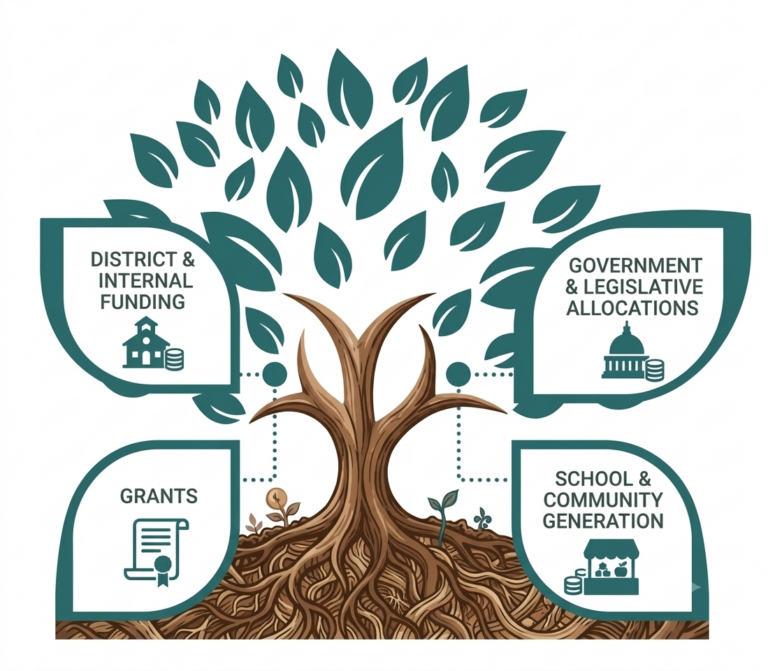
More Ideas on Funding
Jump on over to our Funding School Gardens Promising Practices page which highlights more examples of funding sources. www.sgsonetwork.org/funding
Who Manages District-Run Garden Programs?
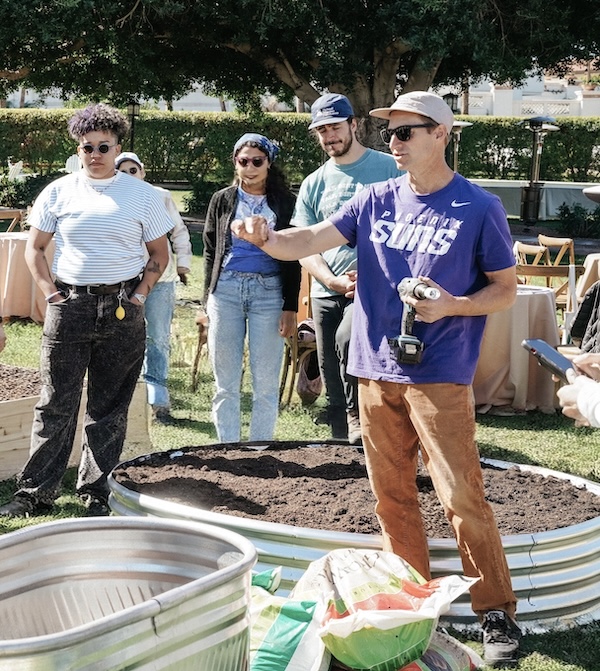
Staffing Models
Jump on over to our Staffing School Gardens Promising Practices page which highlights more examples of how garden programs area staffed including links to job decriptions www.sgsonetwork.org/staffing
Community Partner MOUs
Examples of Contracts and Memorandums of Understanding used to solidify formal relationships between community partners and schools or districts.
Case study summary of the types of roles and positions noted under the staffing and budget heading.
This is the most common role type, providing program administration and school-site coordination.
- School-Site Garden Coordinators: Paid (or volunteer) coordinators assigned to individual school sites.
- Farm to School & Garden Program Managers: Program Managers oversee district-wide initiatives.
Technical and subject-matter experts assigned to manage district- or state-level garden and agricultural programs.
- Farm to School or School Garden Specialists: Housed in district departments, often in Nutrition Services to guide school garden establishment and policy. Teachers on Special Assignments (TOSAs) are another example of how School Garden Specialist roles are staffed. School food service is permitted to spend their budget on garden-enhanced nutrition education.
- Agriculture Specialists: Provide specialized oversight for agricultural literacy programs. Often associated with Career Technical Education or Ag Science/FFA.
- Experiential Learning / Work-Based Learning Specialists: Manage farm-to-school integration and student work programs.
School-based instructional staff who manage or support garden programming.
- Garden Committee Teams: Designated teacher collaborating for site-level garden engagement.
- Afterschool & Club Teachers: Teachers paid or volunteering to support afterschool garden clubs or programs.
- Classroom Educators: Trained teachers integrating garden lessons into instruction.
Paid student positions or interns providing direct farm and market labor. Some FFA programs across the nation has supported high school projects in school gardens.
- Student Agriculture Workers: High school students employed to work on district farms.
- Student Market Workers: Paid student positions running produce markets.
- High School & University Interns: Interns supporting garden operations through school-to-work or university partnerships.
Support staff handling day-to-day maintenance, farming, and operational assistance.
- Farm to School Assistants: Directly support program managers in site maintenance and activities.
- Farm Production Managers: Oversee agricultural production on district farm facilities.
Food service personnel linked directly to garden and farm-to-school initiatives.
- Nutrition Services Director: Executive leadership overseeing food and agriculture programs.
- Dietitians / Dietetic Interns: Staff and graduate level interns combining nutrition roles with farm-to-school coordination.
- District Chefs: Culinary staff conducting cooking classes and taste tests.
External service corps members integrated into district garden staffing models.
- FoodCorps / AmeriCorps Members: Service corps members are often hosted by community-based organizations. Explore your community to see if there are placement suitable to support garden or nutrition education.
Case Studies – Success Highlights
Program Success Themes
- Policy Formalization: Programs achieve lasting stability by embedding garden education directly into district-wide wellness policies and official district initiatives.
- Standards Alignment: Integrating outdoor learning into core grade-level educational standards (from early childhood through high school) establishes garden time as a core academic priority rather than an extracurricular add-on.
- District-Level Coordination: Operating as an official district program removes bureaucratic barriers, simplifies access to internal resources, and ensures better alignment with school food and nutrition services.
- Multi-Tiered Systems of Support (MTSS): Successful programs use surveys and site assessments to classify school needs, delivering customized, data-informed support based on individual school capacity.
- Scaffolded Programming: Offering a mix of low-lift entry points alongside high-capacity production gardens allows schools to participate at whatever level matches their resources.
- Age-Appropriate Learning Progression: Programs successfully scale curricula across grade bands—transitioning from sensory and foundational agricultural literacy in elementary school to engineering, vocational, and career-oriented pathways in secondary education.
- Secured Central Budgets: Programs establish resilience by obtaining dedicated district general fund lines and formal staff FTE allocations, validating district-wide commitment.
- Legislative & Policy-Driven Revenue: Leveraging dedicated public funding streams (such as wellness legislation or local revenue allocations) provides predictable, long-term operational support.
- Internal Synergy: Deep collaboration between garden leads, district nutrition services, food preparation staff, and facilities teams creates shared operational goals (e.g., cafeteria taste tests, kitchen integration, and proper site maintenance).
- Reciprocal Community Partnerships: Programs actively connect with local nonprofits, universities, agricultural organizations, and civic groups to expand technical capacity, volunteer pipelines, and community engagement.
- Actionable Toolkits & Roadmaps: Developing centralized handbooks, standard operating procedures, and site agreement contracts prevents installation and maintenance pitfalls across school campuses.
- Professional Development & Network Building: Hosting large-scale educator summits, peer-to-peer learning sessions, and asynchronous training builds a strong culture of teacher ownership and garden utilization.
- Tailored School Building Teams: Site-level success relies on flexible maintenance structures tailored to school culture, utilizing parent volunteer rotations, teacher teams, and graduation-incentivized service.
- Student Voice & Ownership: Engaging students directly in design competitions, garden cohort rotations, market sales, and paid vocational roles fosters genuine pride and practical work experience.
Successes Per District
- City-Wide Learning Summit: The district successfully planned and hosted a massive learning summit featuring 18 workshops, 35 speakers, 30+ partner tables, and over 200 educators.
- Codified Wellness Policy: School garden programming was successfully codified into the district’s wellness policy, securing it as a valued space for student wellness.
- Community Support: The program successfully rallied passionate, dedicated teacher groups who strongly believe in supporting outdoor gardening programs.
- Scaling Best Practices: They successfully scaled distinct curricula across all grade levels: the Learn, Grow, Eat curriculum for elementary students, an engineering focus for middle school, and a career curriculum for high school.
- Multi-Tiered System of Support (MTSS): By utilizing comprehensive school garden surveys, they developed an MTSS framework to provide effective, tiered support to schools based on their specific needs.
- Legislative Funding: The program established a reliable, sustained funding source through local legislation.
- Multi-Tiered System of Support: They successfully outlined a data-informed framework that delivers different tiers of support depending on the specific needs and capacity of each school site.
- Creating Processes and Scaffolding: They developed a garden handbook that provides a clear roadmap for starting gardens, and they successfully scaffolded their programming—offering both low-lift entry programs (like the Tulip Test) and higher-capacity programs (like food gardens) to meet teachers where they are.
- Cross-Functional Collaboration: The program successfully collaborated across different departments, resulting in outdoor learning becoming an official part of the PreK and K educational standards.
- Engaging Lessons: The program delivers highly engaging lessons that successfully reach a large volume of students in a short amount of time.
- Strong Community Connections: They developed reciprocal community partnerships, resulting in a community that feels deeply connected to the school gardens.
- Secured District Funding: The program received direct district funding to pay for staff positions, demonstrating strong district confidence and buy-in.
- Garden Club Cohort Model: They successfully implemented a garden club model that rotates through each grade level for 6 weeks at a time.
- Partnerships & Collaboration: They successfully extended their community partnerships (such as with FoodCorps) and maintained a close, collaborative relationship with district nutrition services and kitchen staff.
- District-Level Integration: Because the program is district-led, it benefits from high levels of school engagement and frictionless access to district resources like food services and curriculum.
- Dedicated Staffing: The district successfully secured a 0.4 FTE Farm to School Coordinator position.
- Student-Driven Partnerships: Through a partnership with APEX, they utilized an inclusive design process where student teams participate in a “design competition” pitched directly to the district.
- School-Specific Building Teams: They successfully established maintenance and care teams tailored to each school’s environment—for instance, utilizing parent volunteers for summer maintenance at elementary schools, and allowing middle school students to care for the garden to earn silver chord status at graduation.
California Case Studies
 The California School Garden Coalition conducted 10 District Promising Practice Profiles of district-level school garden programs. View a summary of Key Take Aways, Successes, and Challenges of these programs and find links to the full district profiles.
More District-Run Garden Programs & Resources
Berkeley Public Schools Garden and Cooking Program A longstanding district-run program that works to support academic, physical, emotional, and health development of pre-school through high school students. Visit their site to view their district wide curriculum, annual reports and recent news.
University of Arizona School Garden Workshop Connects students in Tucson Unified School District with their local food system and garden-based STEM learning labs. Visit their well developed site to view their program initiative, partners, curriculum, literature guides, and much more!
Hawai’i School Garden Network Hawai’i is comprised of one school district. HISGN provides a network of support to teachers, educators, administrators, and more, offering professional development, advocacy, mentorship and technical assistance, to expand the use of ʻāina (land) based initiatives in 60+ schools across the state.
Minneapolis Public Schools School Garden site provides a district garden map, garden to cafeteria program information and more
Education Outside School Garden Management Resources A unique collection of 50+ School Garden Management and Instructional resources – no need to reinvent the wheel! These resources were made available as Education Outside program closed and transitioned to serve different garden-based Americorps programs. These resources draw from many years of operating a successful garden-based science program in San Francisco city schools. They include everything from curriculum and garden educator training overviews to Top 10 garden infrastructure recommendations. Also included are resources related to Diversity, Equity, and Inclusion. Education Outside hopes you will use and/or share these resources widely.
Garden To Cafeteria Resources – protocols and resources that school districts use to support garden to cafeteria.

Sampling of School District Garden Program Resource Guides
Browse the following guides for ideas to create or enhance your district-level school garden guide.
Planning & Approvals • Gardening & Design Tips • Maintenance Protocols • Student Instruction • Sustainability & Assessment
FCPS Get2Green Together We Grow (152pp) – Fairfax County Public Schools, VA – District Garden Site
Together We Grow (Get2Green) is a comprehensive Fairfax County guide covering the full garden lifecycle—creating, maintaining, rehabilitating, and using gardens as outdoor classrooms—with structured steps for curriculum alignment and administrative support. It also details garden-team organization, site planning, soil and safety guidance, planting/maintenance resources, recordkeeping, and food/cafeteria considerations, backed by appendices and online resources for hands-on implementation.
Jeffco School Garden Guidelines (17pp) – Golden, CO – District Garden Site
JEFFCO’s guide is a practical, year-round operations resource centered on district approval, facilities coordination, site planning, and ongoing maintenance, with robust protocols for volunteer tracking to keep programs sustainable. Older indexed versions of the manual go further into technical details—soil testing, tool and material lists, volunteer paperwork, food safety, funding, curriculum integration, and even a chicken policy.
The DC OSSE School Garden Guide is a thorough, broad resource for starting, maintaining, and using school gardens for instruction, covering everything from seasonal planting calendars to native plant recommendations with a strong emphasis on educational outcomes and community partnerships. Its maintenance section digs further into evaluating and sharing program impact, securing sustained funding, managing summer workload, garden safety, and soil-history/contamination checks, while companion OSSE resources add planting, curriculum, and training support.
School Gardens Guide – Rooted in Academic Sowing Seeds of Wellness Growing Like Vines (168pp) – The School District of Palm Beach County, FL – District Garden Site
Palm Beach Schools’ guide is a highly visual implementation resource tailored to tropical and sub-tropical growing conditions, offering seasonal planting advice and strategies for integrating garden produce into cafeteria programs. It also walks through garden types, site conditions, and management, with particular strength in recommended/prohibited plant selection, irrigation, soil, and fundraising/volunteer support to help schools choose a garden style that fits their needs.
Saint Paul Public School Garden Handbook (57pp)- Saint Paul, MN – District Garden Site
The SPPS School Garden Handbook is the foundational document for the district’s Grow Our Own program, guiding administrators and garden champions in Saint Paul through practical site selection and district approval processes. Beyond startup logistics, it also addresses program standards, department coordination, volunteer management, curriculum ties, and cafeteria connections, and covers ongoing maintenance for sustaining a garden long-term.
Eat What You Grow School Garden Toolkit (37pp) – Chicago Public Schools, IL – District Garden Site
The CPS School Garden Toolkit is built for urban environments, with clear guidance on soil health, contamination rules, and site accessibility to support safe and equitable garden construction. It also functions as a practical, full-lifecycle resource for creating, maintaining, and academically integrating gardens in alignment with CPS wellness policy—covering raised-bed and ADA-accessible design, composting, summer maintenance, and food-related programming.
Denver School Garden Coalition: Resources for Starting a School Garden (30pp) – Denver Public Schools, CO – District Garden Site
Developed with Denver Urban Gardens, this DPS manual establishes formal partnership agreements and design protocols while connecting nutrition education to actionable community garden practices. As a policy-and-program operating manual for schools, community partners, and the district, it’s unusually comprehensive on the partnership model, startup process, funding, Garden-to-Cafeteria programming, volunteer and food-safety policy, garden safety, maintenance, a specific chicken pilot policy, and links to multidisciplinary curriculum and sustainability goals.
LAUSD’s guidebook gives site administrators rigorous, district-specific guidelines for facility maintenance, safety, and infrastructure, making it essential for large-scale implementations. It also guides schools through choosing a garden type, engaging stakeholders, and securing funding—covering five main garden types (habitat, reading, edible, multi-use, and agriculture)—and is complemented by companion LAUSD resources on plants, integrated pest management, curriculum, and greening/maintenance.
Fayette County Public Schools (16pp) – Fayette County, Kentucky
This FCPS slide deck is a launch-stage resource focused on building a garden committee and rallying stakeholder buy-in, with clear, actionable tips for getting a school garden off the ground. Note that the presentation’s detailed content could not be fully verified against the web index, so specifics beyond the committee-formation and startup framing should be confirmed directly against the slides
Sonoran Desert Garden Almanac – annual publication that is designed to connect teachers and learners to the Sonoran Desert and its food systems.
Less of a district resource guide for creating and sustaining school gardens, these almanacs share the power and purpose of regional school gardens by highlighting cultural learning through land, food and tradition. See other regional almanacs.